

by the Rev. Becca Ehrlich
Life transitions and change are inevitable.
Read that sentence again. As you read that sentence, notice what is happening in your body. Are there any body sensations you become aware of: tension, lightness, heaviness, experiences of heat or cold, or something else? Is there movement to those sensations—are they moving to another part of the body, or shifting/changing? Do they go from constriction to expansion, or vice versa?
Are there any emotions that come up when you read that sentence? Do you notice anger, fear, anxiety, excitement, grief, joy, or another emotion?
Reading that sentence, does your body want to do anything specific? Do you want to throw your device across the room? Curl up in a ball? Run away? Scroll to read more?
Is there any meaning that bubbles up? “Change is difficult.” “I have to avoid change at all costs.” “I can’t wait for an upcoming life transition!” “Change means grief.”
Are there any images, songs/sounds, textures, smells, or tastes that come up? Is there a color or shape related to that sentence?
What you are doing when you notice all of the above is called somatics. Soma is the word for body in Greek, and somatics helps us to be more aware of what is happening internally in our bodies so that we can expand our capacity for what life throws at us, feel safer in our bodies, and unwind physiological stress and trauma patterns.
Paying attention to our bodies is inherently spiritual. When we are fully present in our body, we are in the present moment with God, ourselves, and others. We are embodied, spiritual beings.
In consumer culture, we are not encouraged to fully be in our bodies, because it would affect how much we can produce and consume. An embodied, empowered human is less likely to push themselves to produce more when they are tired, and they are less likely to consume to make themselves feel better or to keep up with their neighbor’s consumption. The Enlightenment era also contributed to the idea that the brain is of utmost importance, considering the body less important at best, only a vehicle for the brain at worst.
Though there are plenty of cultures around the world that prioritize and experience the connection within the whole self regularly, many of us have not had that experience. So somatics helps to connect us to our bodies, to listen and notice what our body is saying and what it needs.
Because we are often disconnected from our bodies, change and life transitions can be harder on us because we aren’t able to notice how our body is responding and how we can expand our tolerance for change and stress.
 We crave predictability. As humans, we are physiologically drawn to sameness because it feels safer in our bodies and minds. If things stay the same, we know what to expect, how to act, and what will happen. This is typically a physical survival response; if things don’t change, then it is easier for us to stay safe. Change and transition mean going into the unknown, and the unknown does not guarantee safety. Sameness also doesn’t guarantee safety, of course, but it can feel much safer to our bodies than newness does.
This means that we will often gravitate towards the tried-and-true ways of thinking and being rather than new, different, and creative changes. Even when change and life transitions are good things, like graduation, an addition to the family, starting a new job, moving to a desired location, joining a new faith community, these changes can precipitate big physiological responses in our bodies: body sensations, emotions, images, behavior, and meaning-making.
During changes and life transitions, our bodies and brains may need more rest or more energetic movement or learning (or a combination of both). We may need to change our spiritual practices or how we pray. We may notice images popping up, emotions wanting to move through, our bodies wanting to move differently. We may have deep-seated beliefs about ourselves surface. And during transition times, we may need to meet with a therapist, spiritual director, coach, and/or somatic practitioner in order to work through all that comes up.
I recently went through a big life transition—one that challenged my belief systems, my identity, my relationships, my spirituality. My emotions ranged from anger to hope to grief to joy to fear to anticipation/excitement to disgust to peaceful. My body needed more rest than I ever thought possible. And practicing self-compassion rather than judging myself for how I was responding to the big change was key to working through this transition (along with a great team of professionals!).
When we connect with our bodies and listen, we can better know ourselves, God, and how we can expand our capacity to respond to others and the world around us. We can be fully present with God in a world that aims to keep us looking towards the past or only focusing on what’s ahead. We can join with our whole being—body, soul, mind—in loving and serving God and others.
1. What are some ways you can become more aware of your body during the day (Examples: Can you notice when you’re hungry, when you have to go to the bathroom, when your body needs to move or stay still, when you have an emotion coming up?)
2. How could the idea of being more aware of our bodies inform how you regularly connect with God? What are some ways you can pray/practice your spirituality that incorporate body awareness?
3. Are there any categories of professionals that you’d like to work with in the near future—therapists, coaches, spiritual directors, somatic practitioners? What would you like to work on with them?
Closing prayer:
Loving God, you came into this world as human Jesus, the Divine embodied. Help us to become more aware of our bodies, especially when we are living through life transitions and change. Give us the strength to be curious and self-compassionate with ourselves, and with one another. In your holy name we pray, amen.
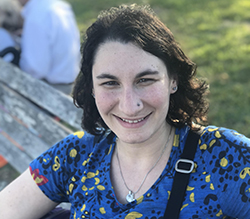 The Rev. Dr. Becca Ehrlich is a PC(USA) pastor. She serves as Executive Director and Founder of New Breath Spirituality Center, and Adjunct Professor of Christian Spirituality at United Lutheran Seminary. She blogs about minimalism from a Christian perspective at www.christianminimalism.com and her book Christian Minimalism: Simple Steps for Abundant Living was released in 2021. Becca is an active spiritual director at Body Spirit Wisdom, where she incorporates somatics and breathwork into spiritual direction with those who have experienced spiritual or religious trauma and/or are seeking healing at the intersection of spirituality and embodiment.
Thank you, Becca! I needed a reminder to pay more attention to my body’s needs instead of trying to ignore them and to be grateful for it. It has served me well for all these years, a real blessing! I always enjoy your articles.